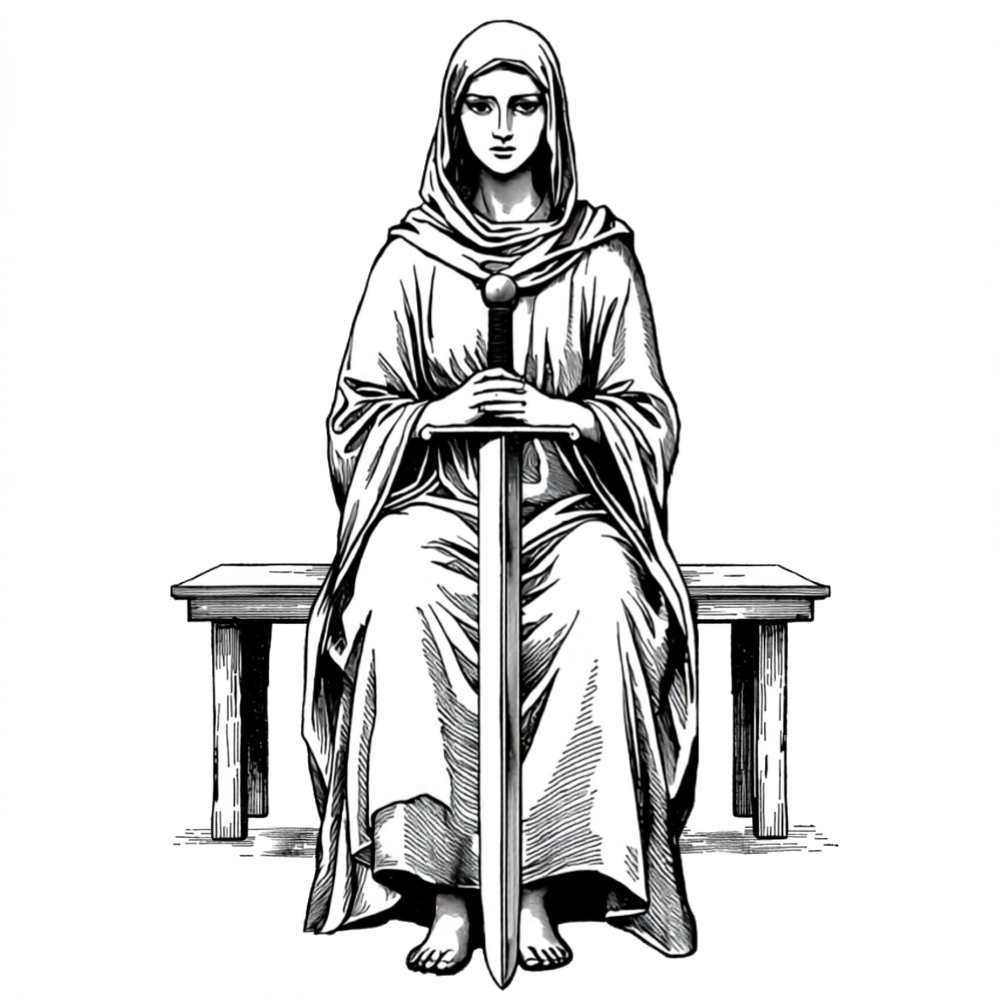
Themis —
past and present guardians.
Behind every man, the law of life. Behind every law, the Mother.
Invocation
Before there were courts, there was the law of life.
She is the mother-of-law — older than every institution that claims her name. Her domain is that-which-is-laid-down-by-divine-ordinance — the order beneath order, the ground on which every legitimate verdict has ever been rendered. Hesiod calls her daughter of Gaia and Ouranos. Aeschylus calls her Themis-Gaia, fusing her with the Earth herself. Homer's kings and judges were not lawgivers but themistopóloi — tenders of Themis, servants of an order they did not invent and could not rewrite.
Then her staff was taken by men who broke it. The blindfold was tied on. The scales were weighted. The sword turned to face the women who came asking for her.
Honourable people honour the law.
She has many names
She does not belong to one civilisation. The same principle surfaces, slain or subordinated, in tradition after tradition.
- Themis · Hellenic · Titaness; mother of Eunomia, Dikē, Eirēnē and the Moirai.
- Tiamat · Mesopotamian · Primordial salt-water; cosmic mother slain in the Enuma Elish.
- Tī-Amma(t) · Tamil substrate · Fire-mother reading of the cognate; pre-Marduk layer.
- Maʿat · Kemetic · Truth, justice, cosmic balance; weighed against the heart.
- Aditi · Vedic · Boundlessness; mother of the Ādityas; the cosmic mother whose sons are the laws.
- Inanna / Ishtar · Sumerian-Akkadian · Queen of heaven; descended and returned.
- Hekate · pre-Hellenic · Triple-formed; keeper of thresholds.
- Pachamama · Andean · Earth-mother; rights-bearing entity in Ecuador's 2008 Constitution.
- Mātṛkā · Vedic-Tantric · The Mothers; cosmological-protective principles.
One principle in many languages.
Mum. Ma. Amma. Mama. Mother.
Our human life-giver. Torch-bearer.
The passionaries
A passionary is one who carries more drive than a life needs and spends it outward — Gumilyov's passionarii, the people a civilisation turns on and later cannot do without. These are hers.
They are set down in two registers, and the division is deliberate. Some of these women the record holds. Some the telling holds. On a page whose whole claim is that the record was tampered with, mixing them silently would be the one unforced error available.
Those the record holds
- the Pythia · Delphi · She had the voice. The institution did the interpreting.
- Hypatia · c. 355–415 CE · Alexandria. Mathematician and philosopher, torn apart by a mob.
- Jehanne · 1412–1431 · Tried by an institution that claimed to hold the law, and convicted on a garment. Nullified 7 July 1456 — twenty-five years late, by the same machinery.
Those the telling holds
- Draupadī · the assembly, and the question no one in it could answer.
- Līlā · the one who went to look, and came back.
- Serpot · the Egyptian tale.
- Otrera · before Troy.
- Zarinaia · of the Saka.
- Tomyris · c. 530 BCE · The steppe. The histories hand down her ferocity and mumble his treachery.
- Thalestris · 330 BCE · Who came to meet a conqueror as an equal.
- Timycha · 320 BCE · Who bit through her own tongue rather than answer.
- Amage · 2nd c. BCE · Who kept an agreement that a king had broken.
- Catherine of Alexandria · trad. c. 287–305 CE · Who out-argued the philosophers sent to correct her.
— the second register is not a lesser one. A story a people kept for three thousand years is evidence of something, and it is not evidence of nothing —